Showing posts with label Primer. Show all posts

Friday, August 22, 2008

Frightfest: Where I Make A Fool Of Myself

Those lovely chaps at Film 4 are currently hosting Frightfest in the West End, which features numerous interesting film choices, including Frank Henenlotter's Bad Biology, the UK premieres of The Strangers and Paul W.S. Anderson's Death Race, and the poorly distributed Midnight Meat Train, which probably won't reach our shores until it's on DVD, thanks to some truly perplexing choices by Lionsgate. It's a crying shame it's been treated so bad, though my condolences go to poor Clive Barker, whose film career never really took off (and yes, I am one of the few who would have loved to see a sequel to Nightbreed). That said, Ryuhei Kitamura is responsible for at least one appalling movie that I wish I had never seen (Versus), and I've not yet seen anything else by him (an attempt at Azumi faltered about twenty minutes in out of sheer boredom), so who knows if it would be any good? Hopefully he has improved a lot. If anyone has any reliable info on that, let me know.


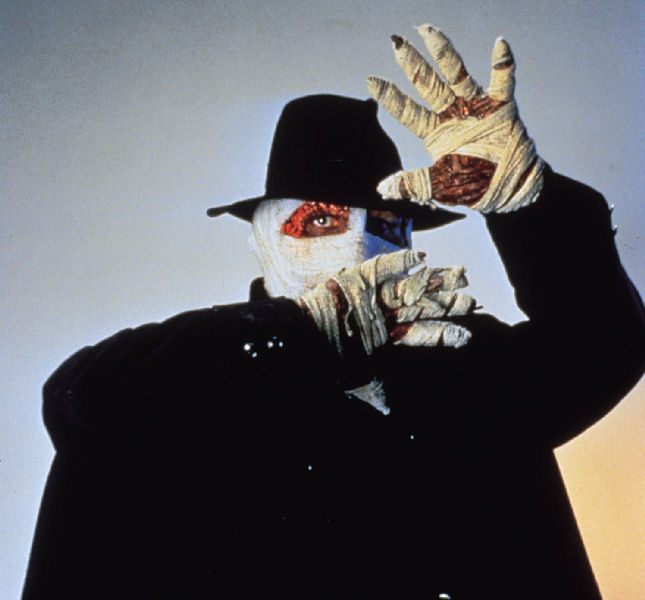
Due to time constraints, I have only managed to get a ticket to see Los Cronocrímenes, aka Time Crimes, written and directed by Nacho Vigalondo, the man responsible for the Oscar-nominated short 7:35 de la mañana. Time Crimes revolves (and I mean that in the temporal sense) around Hector (played by an increasingly confused Karra Elejalde), a man whose nosiness is piqued by the sight of a woman (Bárbara Goenaga) undressing in the woods near his new house. Upon investigating Hector is assaulted by a mysterious man in a long coat and a pink bandage around his head. It's an arresting image, but sadly it makes the strange attacker look like a camp Darkman, a realisation that robbed the character of some of his menace.


Chased by this crazed slasher, Hector hides within a nearby complex, and from that point on, "things" happen, "things" I cannot reveal for fear of ruining the film. I will say that while I enjoyed it a lot (and it becomes pleasantly twisty at about the halfway point), it suffers in comparison to Shane Carruth's Primer, easily the most head-bending time-travel movie yet made. That film will confound me forever more, I reckon, and as a result I'm still not sure how much emotional power it has. It's such a perplexing movie, almost alien in its savant-like dedication to its own obscure rules, that it might be really moving behind all of the cognitive dazzle, but it might not. Guess I should watch it again. And again and again and again and again and again.


Time Crimes, while more conventional than Carruth's experimental mindfuck, wears its capacity for emotional manipulation more readily on its sleeve, and yet the final moments, while pleasingly circular, don't convey the shock I think they are meant to, undercutting them with a teeny bit of humour (of which there is quite a bit throughout). Certainly Hector's resignation to the whims of fate struck me as a bit too comical, and I appreciate that is no kind of criteria to judge a film by, but that's how I have to call it this time. It's still an impressive movie, and I recommend it without hesitation, especially as the time twisting plot is presented very clearly and has been thought through with great rigour, but I couldn't help but keep wondering what the rumoured Cronenberg remake will be like. I can imagine he would make it even more clinical, but perhaps the final twist will be more shocking. Who can say? We don't even know that he's making it, after all.


So, to why I made a fool of myself. The festival is partly curated by film critic Alan Jones, whose reviews were hugely important to me when I was a kid. His erudition and enthusiasm for all genres treated by the mainstream as beneath contempt gave me enormous pleasure, and shaped my viewing habits to a great extent. There are innumerable movies that I have chased down as a result of his recommendations, and my love of film can be at least partly attributed to him. After leaving the screening, I saw him deep in conversation with other noted genre critic Kim Newman, and even though I didn't want to be a jerk I still decided to be rude and interrupt. Though I feel bad about that, I had to shake Alan Jones' hand and tell him how much his work had meant to me. Sadly, as I do not react well in situations where I have to think fast while nervous, my speech about his wonderful criticism and support for the horror and sci fi genres ended up sounding like this.


I also feel a bit bad for not saying anything to Kim Newman, but then I'm still pissed at the drubbing he gave Alien 3 on release. Two stars out of five? Looks like it was filmed through a bowl of oxtail soup? Yeah, I still remember that, sonny, and I can hold a real grudge. That grudge does not remove the embarrassment of the encounter though. Blurg.

Tuesday, January 29, 2008

Lost Countdown: No. 4

Last one for today, and look, only three more to go! Then we can talk about something different. And less AWESOME, probably.

The quirky nature of the mystery itself:

Sci-fi TV and movies of recent years have tended to follow certain formats, with rare moments of invention that give fans of the genre hope that new possibilities are available. Yes, yes, I know, I've gone on about it before. It's one of the main reasons I started my occasional feature Sci-Fi Through Space/Time, in an attempt to find something fresh happening within the genre and then document it.

If it's on film, chances are you're more likely to find something more odd, be it Shane Carruth's Primer, or Michel Gondry and Charlie Kaufman's Eternal Sunshine of the Spotless Mind. On TV, sci-fi suffers by comparison. It's almost always spaceship/portal-based exploration adventure, and even though some of that can transcend the limitations of the format (BSG's ambition and topicality mark it out as one of the best, and Doctor Who's quirkiness hides the format to such an extent that it's easy to forget about it), much of the time it been done before.


Instead of sticking characters on a ship and making them meet rubber people, or badly translating modern scientific theories into layman-friendly action plots or allegories, Lost goes back twenty years into territory covered well by The X-Files, and then improves on it by avoiding that show's episodic nature. Whether it manages to create a series-long mythology that works better than that of X-Files remains to be seen, but I'm hopeful.

When I was much younger, around the end of the 70s, my grandparents bought me a weekly magazine (sorry, partwork) called The Unexplained, which ran for about 167 issues and covered the arena of the paranormal. Week after week there would be in-depth accounts of UFO and ghost sightings, poltergeist hauntings, psychic phenomena and characters like Uri Gellar and Sai Baba: stuff that was very much in the popular sphere at that time.

Even better, it would investigate things that were not as commonly discussed as UFO abductions, such as the supernatural town of Rennes-le-Chateau, or Ted Serios and his ability to put his thoughts on photographic film (see the photo above, where he is going BZZZZT at some film with much mental strain), or Hollow Earth theory. There was stuff on the weird effect of certain types of electromagnetism on humans, areas of the planet that have peculiar properties, the strange theories of Nikola Tesla, Kirlian auras, timeslips, coincidence, the Cosmic Joker... To a kid, this stuff was scary and fascinating. I couldn't get enough of it.

Cuse, Lindelof, Abrams and the writing staff of Lost remember these kooky theories, and have created a fiction set in a world where highly funded individuals of great influence have found that this fringe science actually pays dividends, and have tried to harness this power to save the world. This is sci-fi borne of the forgotten kookery of the 70s and presented in a modern form with a huge budget and even bigger ambition. I also like that whereas most episodic sci-fi has to be set on a ship or near a portal to be able to go places, this show avoids that dreary fate with flashbacks that allows the protagonists to travel within their own lives. With that internal exploration taking the place of the played out external voyage format, the show has room to look to the past (to the time when psychology and paranormal studies were most popular) for its inspiration instead of the near or far future. Retro sci-fi without the rocket packs and laser guns.


So closely does it follow the 70s template that the show is beginning to introduce more themes from that era. It was a period where people began to distrust the power and ambition of big business. Whoever is coming to the island, be they emissaries of Widmore Industries or some other group, are bound to be businessmen trying to take advantage of the island's properties. The Hanso Foundation, though more willing to experiment with odd science, seems similar to the eerie Rand Corporation, which had been busy trying to map the human mind using game theory for a decade, as seen in Adam Curtis' astonishing documentary series The Trap, in which he shows the adverse controlling effects upon the modern psyche by people like John Nash and R.D. Laing. That this show has already dabbled with experiments similar to those created by B.F. Skinner, and has featured a brainwashing device straight out of The Parallax View style (see the clip below), is apt. Lost has plundered the recent past and come back with tons of quirky, long-ignored material and a unique tone for the show. It truly is like nothing else on TV.


Of course, the future direction of the show might take it away from that 70s-era sci-fi paranoia, and perhaps towards a scenario involving either more modern scientific theories (parallel universes seem to be a possibility at the moment, or perhaps time travel), or something even more ancient (the possibility that the island is connected to Atlantis is a popular theory), only time will tell.